The Aegis and the Kataklysmos

The air in the Great Library of Porthmos is heavy with the dust of forgotten ages and the silent weight of sleeping words. I am the First Scribe, and it is my charge to keep these records not merely safe, but understood. Most who come here seek tales of heroism, of shining swords and clever kings. They ask for the comforting lies of history.
But you… you have asked for a Truth.
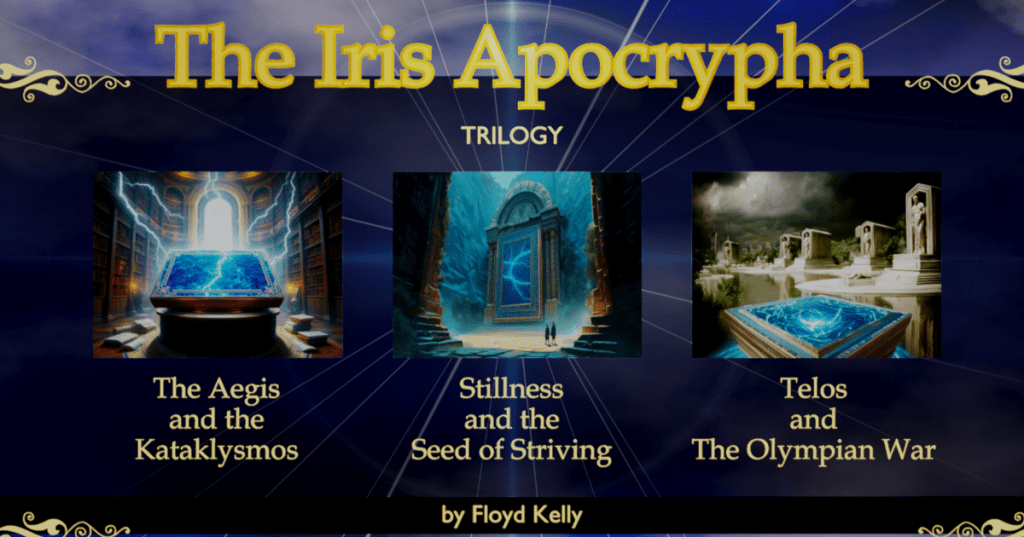
Know that some truths are not comforting. Some are so vast they shatter the scale of a mortal mind. What you are about to read is not a story I have written. I am merely the translator, the vessel. It is a direct transcription from one of the five Prime Tablets of the Kataklysmos, which we keep shielded from the sun in the lowest vault. This one is called the Tablet of Iris, a single, flawless slab of lapis lazuli veined with what appears to be captured lightning. The words you are about to read are not carved upon it; they bloom upon its surface in letters of soft, silver light when a reader is deemed ready.
Many who have seen it have dismissed it as allegory. A myth to explain the rains. I, who have felt the hum of the tablet and watched the words shift as if alive, I will not be so arrogant. I present it to you as it was presented to me: as a true and honest account of the last day of the Old World, and the first day of the new one. Read it, and understand the terrible, beautiful burden of the gods.
Before the doom. Before the hum. The world sang.
A song of glorious dissonance it was. Mountains, granite-boned and still sharp with the memory of their violent birth, tore at the dome of Ouranos. A sky of impossible blue. Below, a deep, breathing green cloaked their shoulders, and the very air was a sensory thing—thick with damp earth, with the sweet rot of blossoms, the salt-sting from oceans so vast they held their own twilight. It was a world of sound. The roar of a waterfall, a constant prayer. The crackling energy of a billion insects. A distant hunting cry, a note of thrilling terror. But beneath it all, something else. A new sound is growing. A low, discordant thrum that vibrated in the soul of Gaea herself, a signal of the great, silent unraveling to come. The coming of Khaos.
On his Olympian throne, Zeus Pater heard the world’s song falter. He summoned the pantheon. Ares, of course, spoke first, his voice the grinding of stones. “Why debate it? The mortal realm sickens. A weakness in its core. Let it burn. A glorious pyre! From its flames, a stronger stock, forged anew.”
Hera’s gaze was imperious. Sorrowful. “Fool,” she whispered, the word cutting deeper than any shout. “You would burn the whole tapestry for one flawed thread. Our, why … is not to judge. It is to preserve. All of it. The virtuous, the wicked, the beast, the blade of grass. Our creation, in its entirety. That is the only answer to an ending so absolute.”
Hera exclaimed, “Telos!” and assumed a heroic posture, summoning forth a throne room full of ancient forest, fireflies, mountains, the faces of all life, all creation, she drifted off and softly sang her favorite lullaby “Oh small ones. Oh small ones. Be safe. Be sweet. Oh small ones. Oh small ones. Be true. Be one.
Zeus’s voice was thunder. It silenced them both. “Enough! The Fates are silent. This is no fate, but a void. And it is approaching now. From below.” His gaze swept the council, then found Iris. Her calm was an island in the storm of divine emotion. “How, then? That is the question. A fire is a blunt tool. We need a creator’s hands.” He turned his full attention to the messenger goddess. “Iris. Tell them the what.”
Iris stepped forward. Her voice resonated with power. “Two movements,” she began, her words a vision. “First, the shield. A gathering of every living soul into a sacred stillness. We lift them from the river of Chronos itself.”
Zeus nodded, a grim weight on his face. He raised a hand. “This first act. This gathering. It shall be the Aegis of Souls. Preservation.”
He let the word hang in the æther. “Then, only then, the second.” His voice dropped, rumbling from the deepest trench of the sea. “I will unleash the waters. The Kataklysmos. A deluge to scrub Gaea clean, to wash away the memory of this decay. Renewal.” A terrible, profound understanding. Heroic. Horrifying. The plan was laid bare. To save everything by destroying it all.
Zeus bellowed with a roar, “Rise! Rise! Oceans of Fury, Rise to the clouds! Telos!”
The commands spoken, the debate died. Zeus nodded to Iris. The Aegis of Souls was invoked. A gentle pull. A divine inhalation. No soul judged, none weighed; the virtuous heart and the venomous spirit lifted alike. For this was preservation, absolute. Not just the king in his hall but the unseen kingdoms in his blood. Not just sequoias, but sunlight woven into its leaves. Not just the leviathan, but the least whisper of being that clung to it. Every mote of life, drawn into the fold.
The last soul was safe. Safe. Then the thunderbolt struck. A single, searing crack of white in the gloom, and the world screamed! Iris wasn’t just its messenger anymore. She was the storm, a living maelstrom, a chaos of shimmering color in a world bleached to gray. Dryness became a forgotten myth. Just wetness. The relentless drum of rain on a world-ocean. The hiss of steam where water met the planet’s molten heart. The crushing, silent weight of the abyss. For five thousand years this symphony of destruction played. Washing away not just life. The very geography that held it.
Then, silence. The final drop fell. The waters receded, revealing a world sculpted by rage. New mountains. New canyons. Continents gleaming under a reborn sun. The air was different. A lungful of pure æther, tasting of starlight. The gods gathered, their forms radiating the ichor within. They had reached their Telos. Their purpose. Zeus did not shout. He spoke the Logos. The divine word of restoration, a singular word of will.
It rippled outward. Not across the land. Through the cosmos. Striking the great, silent tapestry of souls. The celestial architecture, once a realm of frozen time, ignited. What had been a quiet nebula of captured light now blazed. At its heart, two stars, caught in a fiery dance, began to spin, pulsing like a divine heartbeat. Each pulse a great outpouring, a wave of life-force streaming back to the world. Rivers of light. A cascade of returning souls.
As these rivers entered the atmosphere, the sky became a loom. Clouds like divine anvils, capturing the raw essence. Here, the formless given form. The spirit woven to its flesh. The sterile cold of their preservation washed away, replaced by the healing touch of the new world. The sky seeded the planet not with rain. With life itself. A gentle, silent fall of beings, each finding a place. A new body. A new beginning.
In an instant, Gaea breathed again. The good and the wicked, the predator and the prey, flawless in their restoration. The great cacophony returned, purer now, a symphony on a flawless instrument. The work was complete.
And down they looked. From that eternal perch, the pantheon beheld the great work. They were not smiling. Gods do not smile. They were still. A stillness born of a satisfaction as deep and ancient as the cosmos. Zeus, no longer a king of war, but a master craftsman, his hand resting, open, on the arm of his throne. Hera’s gaze, fierce with maternal pride. Iris, her colors a soft, steady glow, the living signature of the masterpiece. A portrait of power at rest. A silent, eternal promise. Guardians of a world reborn.
Stillness and the Seed of Striving
Ten thousand years. A perfect silence.
The Great Library of Porthmos had known nothing else. I am the First Scribe. I have felt each of those years turn, a slow, gentle grinding in the marrow of my bones. I am the keeper of the Prime Tablets. Chronicler of the Great Restoration. Perhaps the last soul who remembers the scent of the Old World’s æther. My lineage, our purpose was to watch. To remember. To teach. And for ten millennia, the world beneath our mountain slept in a perfect, unbroken peace.
The Kataklysmos had washed the world clean. The souls returned, flawless. They built a paradise. No war, for the memory of conflict was ash. No famine, for the new Gaea was bountiful. No great art, for there was no great sorrow. No ambition. Nothing left to strive for. An age of contentment. An Age of Stillness.
But stillness can be its own kind of doom.
I summoned Lyren. My apprentice, my Second Scribe. He is brilliant, his mind a fractured crystal, but he was born into this quiet. This endless peace, to him, is triumph. He does not see the hollow cast of his people’s eyes.
“Master,” he whispered, his voice a disturbance in the hallowed quiet. “You sent for me. Does the Tablet of Iris show something new?”
“It shows nothing,”, my voice the rustle of dry leaves. “And that is the trouble. For centuries, its light was a constant glow. Lately… it dims. Come. We look upon it together.”
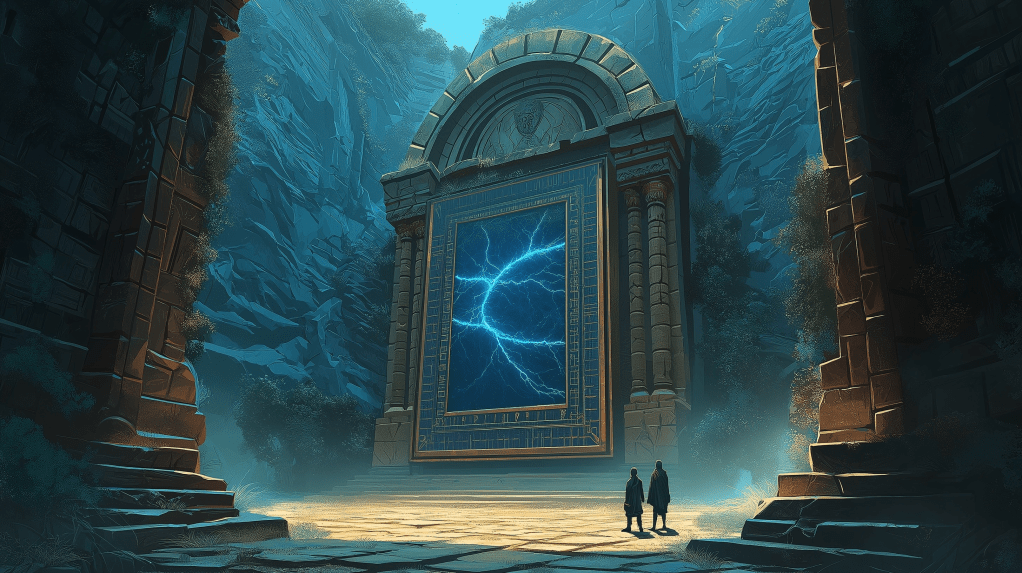
We descended to the lowest vault. To the sunless dark. There it rested, the flawless slab of lapis veined with captured lightning. Its silver light was muted, pulsing slow. A tired heart. It sensed us. The light flared—not with memory, but with a vision that tore time asunder. The ground beneath us trembled, the walls shook and our reality was like a sheet peeled away.
We saw the world. Now. Cities of graceful, pearlescent towers that seemed to hum with a fragile, hollow note. People of unhurried, gentle purpose. Lyren gasped. Awe. “Beautiful,” he breathed. “The promise fulfilled.”
I saw what he could not. The lack of laughter. The death of debate. The placid, horrifying emptiness on every face.
Then, acceleration. The years, peeling away. Shining cities, we watched them decay. Not from war. From neglect. The people stopped building. Stopped exploring. Ceased to create. Their souls, one by one, flickered. No pain. No fear. They simply… stopped. A quiet surrender. But the Tablet of Iris and its vision did not end there. It hurtled forward. Eons in seconds. Our sun, a swelling horror of red, swallowing the inner worlds, boiling the oceans of a long-dead Earth. We saw it collapse. A dying cinder. Then, the Cold.
Lyren cried, shielding his eyes. The tablet held our gaze. Outward. With a lump in my throat, the vision showed us the galaxies themselves age, their light fading to a uniform, tired red. I felt light as if with wings, witnessing the birth and death of stars—not as fiery spheres, but as immense, jeweled hearts that pulsed with cold light and sang in a silent music we felt in our bones. Then there were the massive nebulae that collapsed not into suns, but into great maelstroms where thought itself took form, birthing creatures of angle and echo. The universe we knew was a corpse. A new one, alien and incomprehensible, was stirring in its ashes.
And we saw them again. The souls of humanity. Motes of dust in a vast cosmic cloud and filaments spanning billions upon billions of galaxies. Their souls saved from suffering, yes. But untempered by it. Too fragile. Too simple. Ghosts unable to grasp the new reality, incapable of being reborn into it. Eternal. And irrelevant.
The vision suddenly snapped back. To Olympus. An Olympus outside of time. The very air on the peak was thin and charged, tasting of ozone and unshed lightning. A storm of wills brewed in the throne room. And there they were, we saw the gods. Not in sorrow. In awesome, terrifying foresight. They understood their great mistake. To give humanity a world without struggle was to render them too fragile to inherit the next cosmos. The Aegis of Souls had saved their lives. The Stillness was damning their souls to dust and echoes.
A new council. A new, terrible choice. The vision plunged us into the heart of their debate.
“Poison!” Hera’s voice. Her queenly grace, a brittle shield against a mother’s terror. As she spoke, the air around her throne shimmered with the iridescent, protective colors of the peacock. “You would poison them with ambition? We gave them peace, and you would undo it all for a future you cannot even promise!”
“Their peace is a gilded cage.” Zeus replied. The lightning in his eyes, banked to a smoldering coal. The stones of the hall vibrated with his weariness. “Their souls forget how to fly. We did not give them life. We gave them an endless, dreamless sleep.”
A new voice spoke then, low and resonant, like the cooling of hot metal. Hephaestus. The Great Smith, his massive form a dense core of creative fire, limped from the shadows near the great forge. The air around him warped with heat. “A metal that is never struck grows brittle,” he said, his words deliberate. “Their souls are untempered. They shatter on the softest breeze. A deluge of ambition would be ruin. They need only a spark. A single, exquisite flaw.”
“A flaw?” Ares scoffed. His voice, the grinding of bronze on stone. A scent of ozone and hot blood filled his corner of the hall. “Strength is forged in battle! Give them a sword! Give them an enemy! Let them remember what it is to bleed!”
“No!” The word, sharp. Clear as ice. A sudden chill swept through the throne room as Artemis appeared, as if from the mountain air itself. Her presence, the scent of pine after a hard frost. “A wolf that does not hunt starves. A deer that does not flee is eaten. You gave them a forest with no predators, war-god. Their spirits have gone fat and tame.” Her silver eyes, like chips of the moon, fixed on the Smith, the chill of her presence meeting the heat of his. “What is this flaw you speak of?”
“A seed,” Hephaestus rumbled. “The Seed of Striving. I can forge it. But it must be the smallest possible thing. A quantum of dissatisfaction. The faintest whisper of a question in the soul of one, and only one. A single grain of sand that might, over a thousand years, become a pearl of longing. Too much…” he gestured toward Ares, “And their paradise burns. Too little, and they fade. The balance must be perfect.”
A profound quiet fell, heavy as a shroud. The elemental forces in the room hung in a tense equilibrium. The protective shimmer of Hera’s fear. The low rumble of Zeus’s authority. The hot, metallic tang of Ares’s aggression. The deep, creative heat of the forge. The sharp, clear cold of the hunt.
Zeus Pater broke the silence. “Who, then? Who can wield a thing of such dangerous precision?”
In that moment, the elements resolved. The heat from the forge did not diminish the chill of the huntress. It tempered it, like steel being quenched. The air cleared. All eyes turned as Hephaestus looked at Artemis. “I can forge the Seed,” he said. “But only the Huntress has the aim to plant it without shattering the soul it is meant to save.”
The conflict resolved in that shared gaze. A new path was chosen. Artemis nodded once. A sharp, fierce acceptance. She would be the one.
The tablet’s vision held. Hephaestus turned, his limp a powerful rhythm, and entered the heat-haze of his divine forge. He reached into his own breast and pulled forth a mote of his creative fire. He placed this spark upon his anvil. The sound of his hammer was not a metal clang. It was a series of soft, resonant chimes, a tuning fork that could set a world vibrating. With each strike, he folded the fire, shaping it, cooling it with his own patient breath, compressing boundless energy into a single, infinitesimal point. The final spark rested on the anvil, no longer fiery but a thing of shadow and starlight, absorbing all light, pulsing with a barely contained power.
Hephaestus scooped the Seed into his calloused hands and approached Artemis. She stood, the spirit of the wild moonlit night, her silver eyes focused, her form an aura of absolute stillness. He held it out. As she accepted her charge, a giant halo formed from within the heart of Artemis, starpoints of gold and silver light pulsing outwards. She did not shout. She did not speak. She simply breathed out a low, ancient chant, the words not of any human tongue, a sound of pure will and focus:
“Ai-ē-thos… Ai-ē-lune… Ai-ē-telos!“
“Ai-ē-thos… Ai-ē-lune… Ai-ē-telos!“
(Spirit… Moon… Purpose!)
Then she ascended. Our vision followed her; a silent arrow of shadow and starlight aimed at the heart of a sleeping world. She passed through the skies above like a moonbeam through a broken cloud, her presence leaving no trace but a momentary chill. We saw her stand over a single mortal—a young man sleeping in a green field of silent, perfect flowers—and for a moment, the Huntress’s face held a look of profound, sorrowful compassion. This was a wound she was inflicting. A necessary one.
Our vision plunged inward, following the Huntress’s intent. We passed through skin and bone, our gaze moving beyond the mortal into the landscape of a man’s dreaming soul. It was a place of profound stillness. An endless, glassy sea beneath a sky of pearlescent light. No wind. No clouds. Perfect tranquility. Perfect emptiness. As Artemis stood, an ethereal presence on this silent shore, the only sound was the faint, dissonant hum of the Seed she held, a single, insistent note in a universe of silence.
Suspense hung in the soul-scape. She held the fate of this new age between her fingers. Too much force, and this placid sea would erupt into a maelstrom of madness that would consume the mortal. Too little, and the Seed would simply dissolve, its potential lost forever in the endless calm. She knelt. With a touch as light as falling frost, a touch that took all her divine concentration, she gently placed the Seed of Striving upon the surface of the silent, dreaming water.
For a heartbeat, nothing happened. Then, a single, dark ripple spread outward. A perfect circle of motion in a world that had known none. The sound was not an explosion. It was a single, low musical note, a cello’s melancholy song played in a world that had only known major chords. It was the sound of longing. It was the birth of the question. As the ripple touched the far shore of the dream, a single, solitary cloud formed in the unwavering sky, casting the first shadow the soul had ever known.
The vision died. The tablet’s light, a dim pulse once more. Lyren was on his knees. His face, pale with a cosmic horror I knew well. “They would sacrifice paradise?” he whispered, his voice a tremor.
“No”, my voice filled with a new and terrible awe. I placed a hand on his shoulder. “They would forge a people strong enough to survive a dying universe. They would give them a soul that could be reborn.”
Our work was no longer to remember. It was now to watch for the coming of this new, necessary age. To chronicle the return of imperfection. To bear witness to the painful, heroic, and beautiful rebirth of the human spirit.
Telos and The Olympian War
It began with an act of terrible love. My ancestor, Lyren, the Second Scribe, told the story of his master and the first vision until the day he died. He spoke of the Aegis of Souls, a divine preservation that lifted every soul from a world doomed by a silent, cosmic unraveling. His grand stories of the Kataklysmos, the five-thousand-year storm that washed Gaea clean, were legend in our halls. But he would always fall silent when it came to the second truth held within the Tablet of Iris, a vision he could never bring himself to witness.
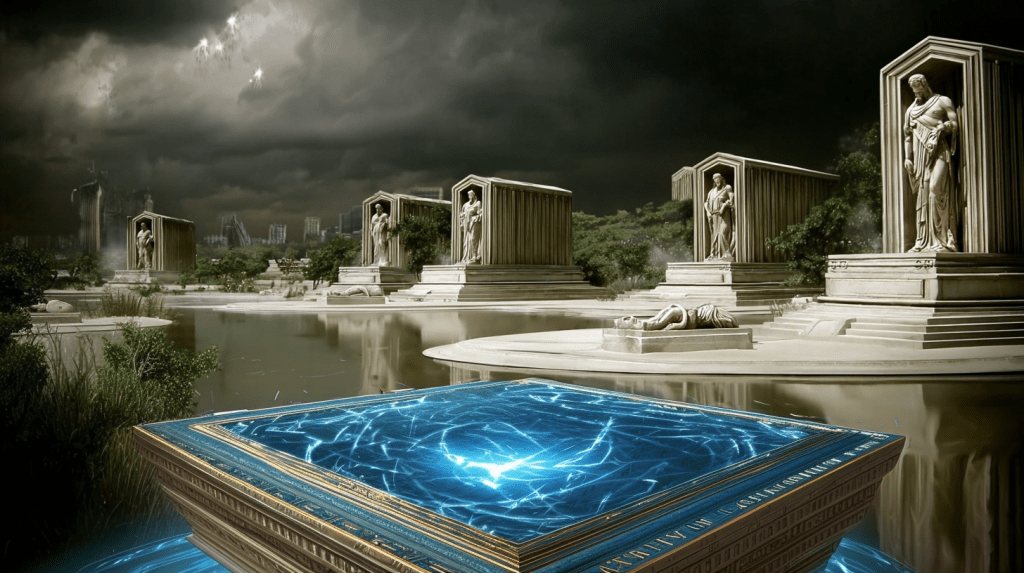
Now, generations later, that burden falls to me. I am Jude, the Fifth Scribe. I have been here a while now. Alone. I approached the Tablet of Iris. I’m feeling a weight of my unknown fear. Slowly. Slowly, with my trembling hand, I stretched my arm out, my palm hovering above the flawless lapis lazuli. The second I did, the tablet stirred and began to glow! The captured lightning within its veins began to move and come alive, and the silver words bloomed upon its surface, deeming me ready.
What follows is the chronicle of this second vision… the truth of the terrible, beautiful war.
The Tablet shows me a young man asleep on a bed of impossibly tailored green grass, a quiet field nestled within the heart of a city built from dreams. He is dressed in simple white. Near his head grows a single, tall flower, a bloom of impossible, regal purple.
He stirs. A slow, gentle awakening. A smile touches his lips before his eyes even open, the pure, unthinking contentment of a soul that has never known want. His eyes flutter open, and the first thing he sees is the tall purple flower. He does not know it is the color of a royal bruise upon the skin of his world.
The young man, whose name seems to be Kaelen, sits up. The Tablet vision shifts to his perspective. Before him, rises a city of pearlescent light and swirling, crystalline glass, humming with the gentle, omnipresent energy of perfection.
Kaelen takes it all in. The smile remains. It is his home. It is all there is. He places his hand on the soft grass to push himself to his feet. And it is then, in that simple act, that the ripple of the Seed of Striving finally reaches the shore of his waking mind.
His hand stops. His smile falters.
For the first time in his life, for the first time in any human life in ten thousand years, a question, unbidden and terrifying, forms in the quiet stillness of his soul.
Is this all there is?
The question lingered. He stood, and a new feeling arose: a desire to be somewhere else. He traveled to the Grand Planetarium, where he saw an unfamiliar woman, her fingernails painted the same impossible purple as the flower. A longing to know.
Kaelen returned to the field. With a soft, tearing sound, he plucked the flower. The first life had been taken. The sound, unheard by any mortal, was a shriek of violation that ripped through the cosmos, causing the guide star Pegasi to flicker. The wave of grief pierced the vast cosmos and rupturing moons afar.
The Tablet’s vision snapped to Olympus. Artemis flinched. Zeus shifted on his throne. Hephaestus paused at his forge. Ares let out a low, satisfied grunt. The first conquest had been made. The clouds below began to billow with darkness.
They see Kaelen clutching the flower. Another man approached, his eyes filled with a new and dangerous emotion: want. “I must have it,” he whispered, offering his rune-band. Kaelen, feeling a new possessive instinct, refused. “It is not enough.” The man, desperate, added his neuralnet to the offer. Kaelen, feeling the strange new power of having something another coveted, accepted. The first transaction was sealed.
I can now sense the aroma of violets. The Tablet’s vision blurred, then focused on Kaelen, a decade later. The vision keeps changing showing 10 years have passed. The Seed of Striving has taken root. Kaelen is no longer a simple youn man in white, but a leader, an innovator, clad in fabrics of deep purple and gray. His original field is now a walled garden, filled with cultivated purple flowers, their seeds a currency of influence. I can see the cityscape has begun its slow transformation. The uniform pearlescent white is now streaked with gentle grays, the byproduct of the first small forges and workshops Kaelen and his followers have created. The gentle hum of perfection is now punctuated by the distant, rhythmic tap of hammers.
A generation gave way to the next in the space of a breath. Kaelen’s youth had been traded for a face etched with the lines of thought and concentration, and he now stood on a high balcony, looking out not at a unified place, but a divided one. The cityscape is now a patchwork of sectors. His sector, ‘Cobalt Bronze,’ is a place of ceaseless industry, the towers stained with a permanent, gritty soot. The sky above it is no longer clear but hazed with a gray pallor. In the distance, other sectors remain pristine, people having walled themselves off, clinging to the old ways of Stillness, viewing Kaelen’s people with fear and suspicion. The first tribes have hardened into the first nations.
The vision filled the entire room and propelled me forward to Kaelen’s final moments when he turned seventy. He died not of violence, but of a life lived with the fire of the Seed of Striving burning within him. He lies in a chamber atop a blackened crystal spire. Through a vast window, he looks at the nebula with its colorful and luminescent glory. Behind him, the city is a scar. His sector is a realm of apocalyptic ruin and furious industry, its towers belching smoke that chokes the sky. Beyond it, the still and peaceful are besieged by the corrosive fallout of his progress. The world is broken into factions, the seeds of war already sown. As he takes his final breath, we see no peace in his eyes, only the horrifying, complete understanding of what that single, beautiful, terrible question—Is this all there is?—had truly wrought.
It is at this point, with Kaelen’s death, that the Tablet’s vision sharpens, pulling my senses fully into the roaring, violent present of Olympus. A tempest raged on the sacred mountain, a physical manifestation of divine anguish.
Zeus sat upon his throne. Not a king. A being carved from granite and regret. “Enough!” his voice, the reverberating sound of a world breaking. “We have debated for centuries while our creation burns. The time for philosophy is over.”
The Tablet vision flickered wildly and showed me the truth of their powerful war. The first armies of humanity marched under banners of ideology, their soldiers clad in simple metal, carrying shields of hammered bronze. But as centuries passed, their genius for destruction grew exponentially.
I became frightened when I saw the grand legions of soldiers, millions strong, marching in perfect, terrifying unison across the scarred continents, a river of armor flowing through the ruins of their own progress. Their shields were no longer metal, but shimmering fields of translucent liquid held in shape by magnetic force. When struck by any weapon, the liquid shields did not break; they flashed with a brilliant point of defiant purple light, the color of the first plucked flower, now the color of their war. The onslaught of their oppression was relentless, their power beyond belief.
The ground below me became warm the ambient air suddenly dry when I chronicled Ares, standing before the swirling vision of Earth, raise his blackened spear. The scent of ozone and hot blood filled the air as he slammed the spear’s butt against his shield, the sound a crack of brutal thunder. He let out a great, guttural roar, a command of pure war:
“Phobos! Deimos! Telos!“
(Fear! Terror! Purpose!)
The words did not simply echo; they became a psychic shockwave that ripped through the void.
The Tablet’s vision projected me to the space armadas, poised in perfect, arrogant formation. Then the wave hit. Static images appeared and the vault became chilled as I see the commanders suddenly recoil from their screens, their faces pale with a nameless dread. Their targeting systems flicker as pilots flinched from phantoms in their peripheral vision. The perfect formations wavered, a subtle but fatal hesitation instilled across the entire fleet. They were now an army gripped by a sudden, inexplicable terror, sown by the god himself.
The tablet placed me in the middle of a vortex of smoke and brimstone and I felt Ares descend, not as a man, but as a crimson comet of pure force. He fell upon their powerful armadas, his rage bending gravity itself, tearing warships apart with invisible hands.
Humanity responded. They unleashed weapons that folded space, attempting to trap Ares in pockets of distorted time. Their flashes of conflict lit up the void, a ballet of brutal physics and divine fury.
I thought I started to see ghosts here in the vault when the Tablet showed me Hephaestus become a ghost in their perfect networks. His presence was a creeping rust of logic. A single, flawless equation in a targeting system would suddenly contain an elegant, unsolvable paradox, causing a planet-shattering weapon to fire a beam of harmless, beautiful light into the abyss. The humans fought back. They created quantum intelligences, chaotic and unpredictable, that could anticipate and attempted to wall off the Smith’s influence, learning from his divine sabotage to build ever-stronger systems.
Suddenly, the Tablet of Iris came alive, the pedestal changed and appeared as if adorned with luminescent cobalt shapes and the mortar between bricks in the walls of this vault grew veins of sapphire and then … Artemis.
She was a whisper in the dark. A flicker of moonlight on a command screen that would reveal a planted lie. A sudden, unnatural frost that would cause a crucial communication relay to fail a second before a ceasefire was broken. Her hunt was for the threads of command, the sinews of hatred. She severed them with perfect precision. But for every warlord she isolated, for every lie she exposed, humanity, in their boundless ingenuity, wove three more. The hydra of the Seed of Striving became a formidable force.
The vision then focused again on two final factions. The last great powers. They had built weapons that defied imagination—one, a device that could unravel the very fabric of matter; the other, a wave of ichirós that could shatter a planet’s soul. The vision zoomed in split to show me the two leaders. Their faces, masks of hatred in their thrones of strategy. Their fingers hovering over the final rune. No more time! The rune was about to be pressed!
The war was almost lost, and the eternal bond between the gods recognized the situation for what it was: an unsolvable tragedy.
Zeus looked at the assembled gods. His gaze swept over each of them. The anguish was still there. But it was now dwarfed by a profound, final resignation. Their grand experiment had failed. “They stand on the brink!” he roared, his throat trembling, devoid of all hope but one. “Another restoration will only repeat the cycle… but it is the only mercy left to us. We will not be their gardeners. We will not be their storm. We will be… their beginning. Again.” He looked to the edge of the throne room. To Iris.
“The time has come,” Zeus commanded. “Invoke the Aegis of Souls.”
Iris nodded. A single, sorrowful tear traced a path of pure light down her cheek. She ascended into the cosmos, zooming through nebulae and starstream. Through the cosmic web of galaxies, through the dark matter, fleeting along the cosmic filament; her very presence in the æther was the signal. Preservation and The Great Restoration began again. Images flashed showing the rapture of all souls, so many, the general in his bunker, the scientist in her lab, the wicked and the righteous, all raptured to preservation, all life held in nebulae slumber until the Logos.
When the last soul was safe, Zeus gave the final order. The Kataklysmos. His celestial-sized figure dwarfed the planet and bellowed, “Rise! Rise! Oceans of Fury, Rise to the clouds! Above the mountains and new seas! Telos!”
The echo of his Telos was not contained to the vision. It was a physical force. The ground of the vault rumbled, the Tablet of Iris vibrating with power. Dust, dormant for ages, rained from the ceiling. The Tablet itself began to hum, a low, powerful thrum that I felt deep in my chest, its captured lightning flaring with starlight energy.
This time, the storm was born not of anguish. Of grim, weary duty. A single, perfect bolt of lightning struck the ocean, a great chasm and Gaea screamed once again! I watched as a moving mountain tower of black water, a liquid apocalypse, scraped the bellies of the clouds! They did not crawl; they lunged. The very sky vanished, blotted out by the sheer height of a single wave’s crest as it curled over the city’s highest, obsidian peak, a liquid midnight poised to fall. The impact was not a crash, but a deep, resonant thrum that shook the Tablet’s vision itself, the sound of a world’s foundation cracking as the black crystal fortresses, designed to withstand the fury of fusion and thought, were turned to glittering dust by the simple, ancient power of water. The lightning was constant, a strobe of divine fury illuminating a paradise being washed clean of the very flaws the gods themselves had introduced.
The Tablet’s vision held on this spectacle of destruction. Amazing! Iris returns in glory to start the five-thousand-year cycle once again. The ultimate act of destruction and reconstruction. The final, tragic fulfillment of the gods’ burden to protect their creation, even from itself. The circle was now complete.
The Iris Apocrypha by Floyd Kelly 2025





 Floyd Kelly
Leave a comment